
The Rule Underneath: OT firewall priority traps
White paper: how tightening one firewall rule can hand its traffic to a broader rule underneath, and four questions to ask before any change.
White paper, October 2026. Written for OT security consultants and the network teams at industrial sites.
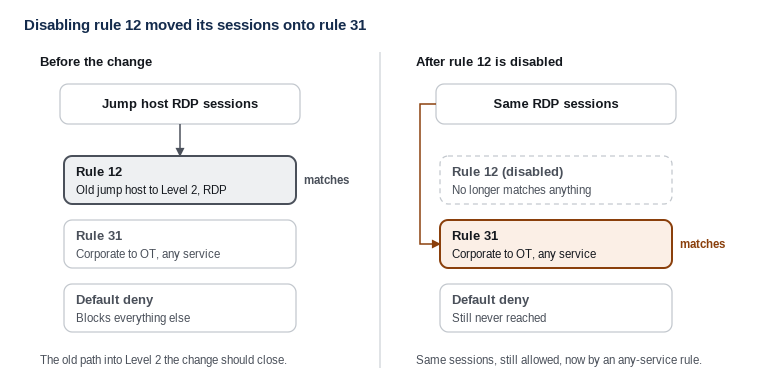
The most dangerous firewall change at an industrial site is often the one meant to make it safer. Firewalls act on the first rule that matches. When a reviewer disables or narrows a broad rule that is carrying live traffic, that traffic does not simply stop: the firewall keeps reading down the list, and the next rule that matches takes over. If that rule is older, wider or forgotten, the path stays open through a rule nobody meant to carry it, while the change ticket says it closed.
We call this a priority trap. Hit counts and rule reports do not reveal it, because the rule underneath has never been hit while the rule above it was in place.
What’s inside
- A tightening that closed nothing. A worked example of a routine change that left the path open through a 2017 vendor rule.
- Why it happens. Three properties of ordered rulesets that combine into a trap.
- Why OT firewalls are especially prone. Old rulesets, broad fixes added at 2 a.m., seasonal traffic and layered firewalls.
- Five warning signs that a ruleset needs a closer look before anyone tightens it.
- Four questions before any rule changes, for every change ticket on an OT firewall.
- What a change package a site can trust contains, from the order of changes to rollback.
Six pages, as a PDF. Enter your work email below and we send you the link.
Get the white paper
Run the free Quick checkSee a sample deliverable
Last updated .